Industrial steam cleaner runtime matters when cleaning must fit into a maintenance window or support repeated production tasks. A machine may be ready to produce steam, yet the buyer still needs to understand its refill procedure, output under load and required operating pauses.
The useful question is more specific than “How many hours can it run?” Ask how the proposed machine performs through your actual sequence of steaming, moving, wiping and inspecting.
These six questions help buyers evaluate an industrial steam cleaner for sustained work without relying on an undefined promise of continuous operation.
1. What Does “Continuous Operation” Mean for This Model?
Start by asking the supplier to define the term.
It may refer to adding water without shutting down the boiler, operating for an extended cleaning session, or maintaining a stated output under specified conditions. Those descriptions should not be treated as interchangeable.
Some steam cleaners use a separate refill tank to support replenishment during operation. That feature answers a water-filling question; it does not, by itself, establish the output available at every setting or the permitted operating schedule. Kärcher
Request a written explanation covering water replenishment, steam demand and any required pauses. Use the manual for the exact model as the reference.
2. How Is Steam Output Specified During Use?
Maximum pressure and temperature do not fully describe industrial steam cleaner runtime.
Ask whether the published pressure is a maximum value, a boiler reading or a stated operating condition. Likewise, establish where temperature is measured. A boiler temperature should not be presented as a verified temperature on the component being cleaned.
Where steam production is specified, ask for its units, measurement conditions and the output setting used. Confirm whether that value describes sustained production or another test condition.
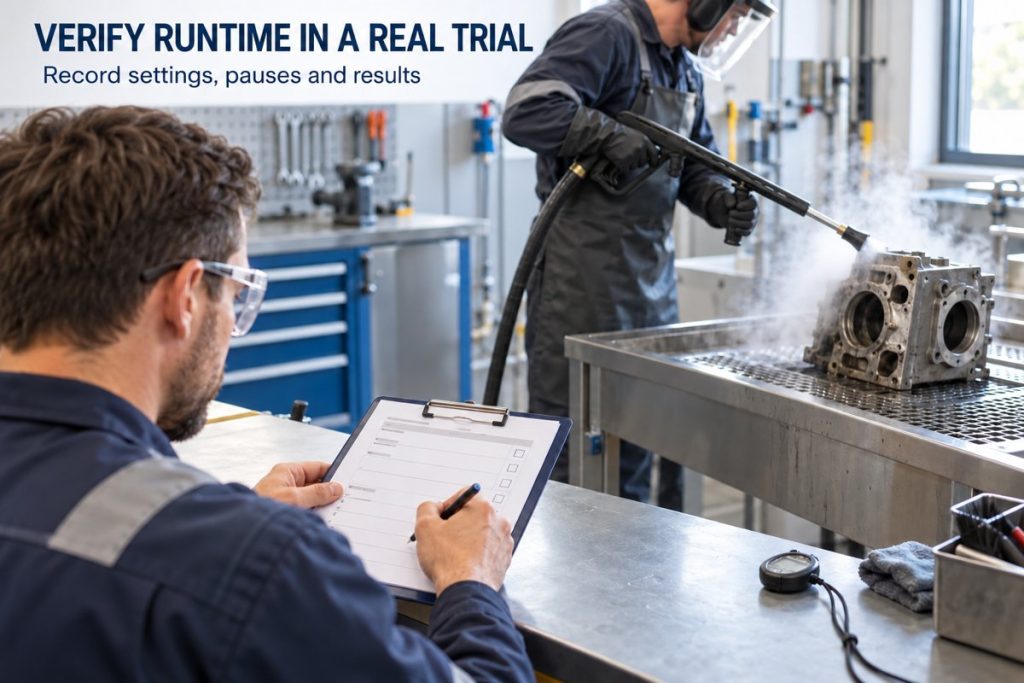
During a demonstration, observe the equipment through a representative cleaning sequence. Record changes in the displayed conditions and any pauses needed to continue at the agreed setting. Do not judge sustained performance from the first short burst alone.
3. What Happens When the Water Supply Runs Low?
Ask the supplier to explain the complete refill procedure.
Confirm whether the operator replenishes a separate unpressurized reservoir, whether an approved water connection is available, or whether the machine must stop and follow a cooling and depressurization procedure.
Do not assume every industrial steam cleaner permits refilling during operation. A procedure demonstrated on another model may not apply.
Also confirm how the equipment indicates low water and what the operator must do afterward. Include access to the filling point, water handling and restart steps in the evaluation.
For purchasing purposes, distinguish tank capacity from working duration. Ask for any runtime estimate to be tied to the actual output setting and usage pattern.
4. Can the Site Support the Proposed Operating Conditions?
Check the available supply against the exact configuration being offered.
For an electrically heated machine, confirm voltage, phase, frequency, current requirements and the approved connection arrangement. For a fuel-heated configuration, request the corresponding fuel and installation requirements.
A machine specification should be evaluated against the services available at the intended work location. Do not assume that a socket, adapter or supply used elsewhere will support the proposed unit.
Ask what water quality the manufacturer requires and what maintenance follows from local conditions. Include access for servicing and routine checks when planning the installation or storage area.
Industrial steam cleaner runtime should be discussed together with these site conditions, rather than treated as a machine-only number.
5. How Much Steam-On Time Does the Job Actually Require?
An hour assigned to cleaning is not necessarily an hour of uninterrupted steam delivery.
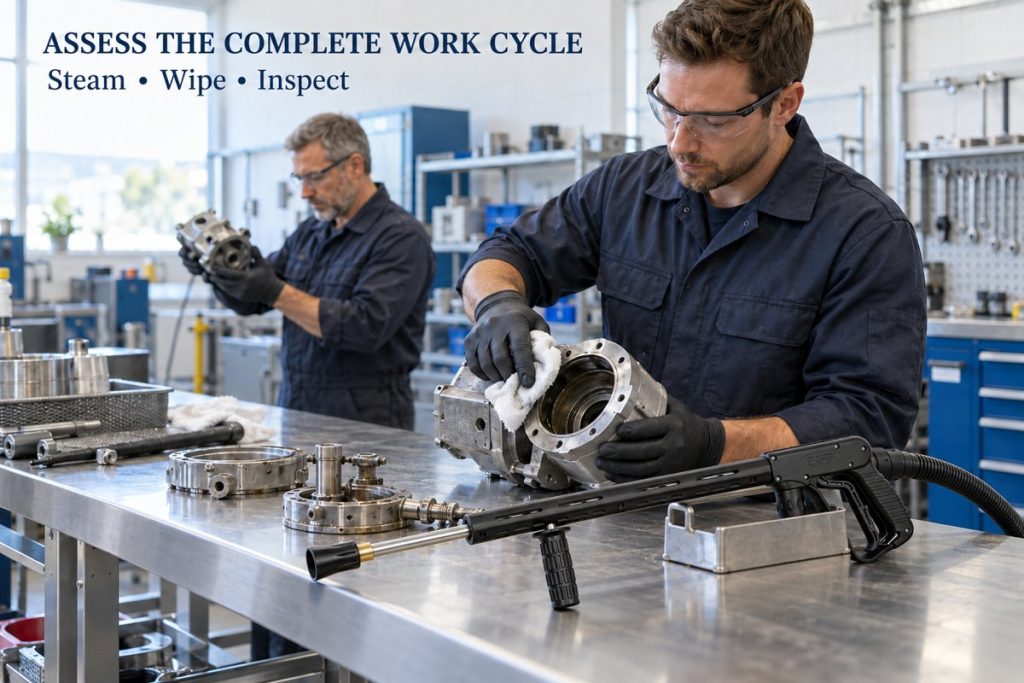
A technician may steam a surface, remove loosened residue, reposition a component and inspect the result before continuing. Another application may need much longer steam-on periods.
Record the work sequence before comparing equipment. Include:
- The longest expected steam-on period.
- The number of repeated cleaning cycles.
- Time spent wiping, brushing or moving the component.
- Any required collection or extraction step.
- The complete cleaning window.
Use those observations to build a demonstration that resembles normal work. Compare configurations against the same task and completion criteria.
Also confirm whether residue removal needs separate equipment. A pure industrial steam system should not be assumed to include vacuum extraction.
6. How Can You Verify Industrial Steam Cleaner Runtime?
Request a demonstration long enough to show the relevant operating pattern, rather than specifying an arbitrary duration for every application.
Agree on the component, contamination, accessory, output setting and required result before starting. Record initial heat-up, active cleaning, refill events, recovery pauses and total completion time.
A simple evaluation sheet can include:
| Item | What to record |
|---|---|
| Equipment | Exact model and configuration |
| Site services | Supply conditions used during the trial |
| Accessories | Hose, tool and selected output setting |
| Work pattern | Steam-on periods and other cleaning steps |
| Interruptions | Refilling, recovery and other pauses |
| Result | Whether the agreed cleaning requirement was met |
Keep the observations with the quotation. If the proposed configuration changes, ask whether the earlier demonstration still represents the equipment being purchased.
The aim is to understand industrial steam cleaner runtime for a defined job, with the assumptions visible.
Questions to Ask LIEYING
When discussing industrial steam cleaning with LIEYING, share the component, contamination, available services and expected working pattern.
Explain whether the task involves short repeated applications or longer steam-on periods. Include the required cleaning window and any separate wiping or extraction stage.
Ask for the exact model specification, filling procedure, operating limits and accessory configuration. Request application evidence for the proposed arrangement instead of applying one model’s capabilities to the entire range.
Explore LIEYING industrial thermal cleaning solutions and prepare your application details for the discussion.
Frequently Asked Questions
Does a larger water tank guarantee longer uninterrupted cleaning?
Tank capacity alone is insufficient. Working duration also needs to be assessed against the output setting, refill arrangement, usage pattern and model instructions.
Does continuous refill mean maximum output is available indefinitely?
No. Refill capability and sustained steam output are separate questions. Ask the supplier to specify both under the intended conditions.
Is a higher maximum pressure proof of better runtime?
No. A maximum pressure figure does not establish how the machine performs through a prolonged cleaning sequence.
What should buyers request first?
Start with the exact model manual, a clearly defined output specification and a representative demonstration. Use those together to assess suitability for the task.
Further Reading
For an example of a manufacturer-described two-tank refill arrangement, see this steam cleaner technical overview. Its features apply to that product and should not be transferred to a different model.