
Industrial pressure washer power requirements should be checked before a purchase order is approved. A machine can suit the cleaning task while still needing a different electrical supply from the one available at the intended work area.
For overseas buyers, a request such as “industrial voltage” leaves too much unanswered. The supplier needs the actual voltage, phase and frequency, together with the site connection details. Buyers also need to understand what the quoted power figure represents.
This guide provides a purchasing checklist for discussions between the equipment supplier, the maintenance team and the site electrician. It is not an installation or wiring guide.
Contents
- Match voltage, phase and frequency
- Separate motor power from heating power
- Confirm rated current and starting requirements
- Review the actual connection location
- Document the agreed configuration
1. Match Voltage, Phase and Frequency
Start with the supply available at the installation point, rather than a general description of the country’s electrical system. A facility may have different supplies in different areas.
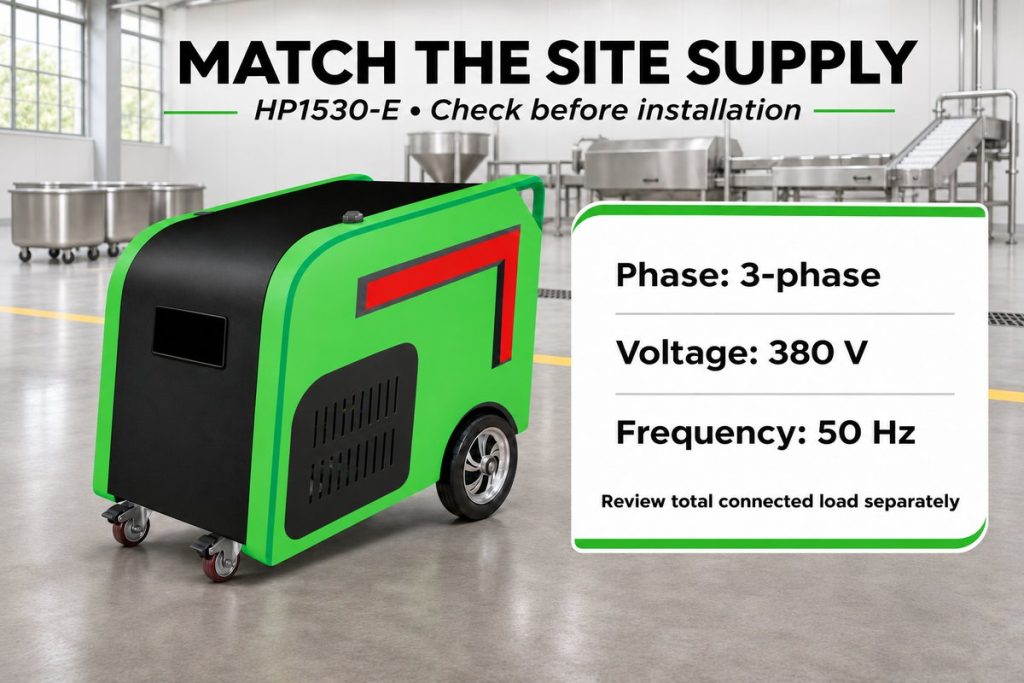
Record the voltage, whether the connection is single-phase or three-phase, and whether the supply frequency is 50 Hz or 60 Hz. Ask the supplier to confirm compatibility for the exact machine being quoted.
Voltage, phase and frequency are separate specifications. Cat Pumps lists each of these among the electrical motor characteristics relevant to drive selection. A matching voltage alone does not establish that the complete system is suitable.
For purchasing purposes, put the agreed supply specification on the quotation and order confirmation. If a machine will move between facilities, identify every intended supply before selecting its configuration.
Checking industrial pressure washer power requirements early gives both sides time to resolve differences before production or shipment.
For background on motor specifications, see the Cat Pumps drive selection guide.
2. Separate Motor Power from Heating Power
A power figure is useful only when its meaning is clear. Ask whether it refers to the pump motor, an electric heating unit, or the complete machine’s electrical input.
A hot-water system may use electricity to drive the pump and a separate energy source to heat the water. Another configuration may use electricity for both functions. These arrangements should be compared using complete specifications rather than a single kW entry.
When reviewing industrial pressure washer power requirements, request separate entries for motor rating, electric heater input where applicable, auxiliary electrical loads, and the manufacturer’s declared total connected load.
Do not treat the headline motor rating as a circuit-sizing instruction. The equipment supplier should provide the electrical data for the complete assembly, and the site electrician should assess the proposed installation.
3. Confirm Rated Current and Starting Requirements
Include rated input current and starting arrangements in the technical discussion. Ask the supplier what information the electrician needs to assess the machine under both starting and normal operating conditions.
Useful purchasing questions include:
- What is the complete machine’s rated input current?
- What starting method is fitted?
- Are there manufacturer requirements for the supply or protective devices?
- Which electrical drawings and commissioning instructions are supplied?
Avoid selecting breakers, cables or adapters from motor power alone. Those decisions require the machine documentation and an assessment of the actual installation.
Industrial pressure washer power requirements should be resolved through documented compatibility, rather than trial connections after delivery.
4. Review the Actual Connection Location
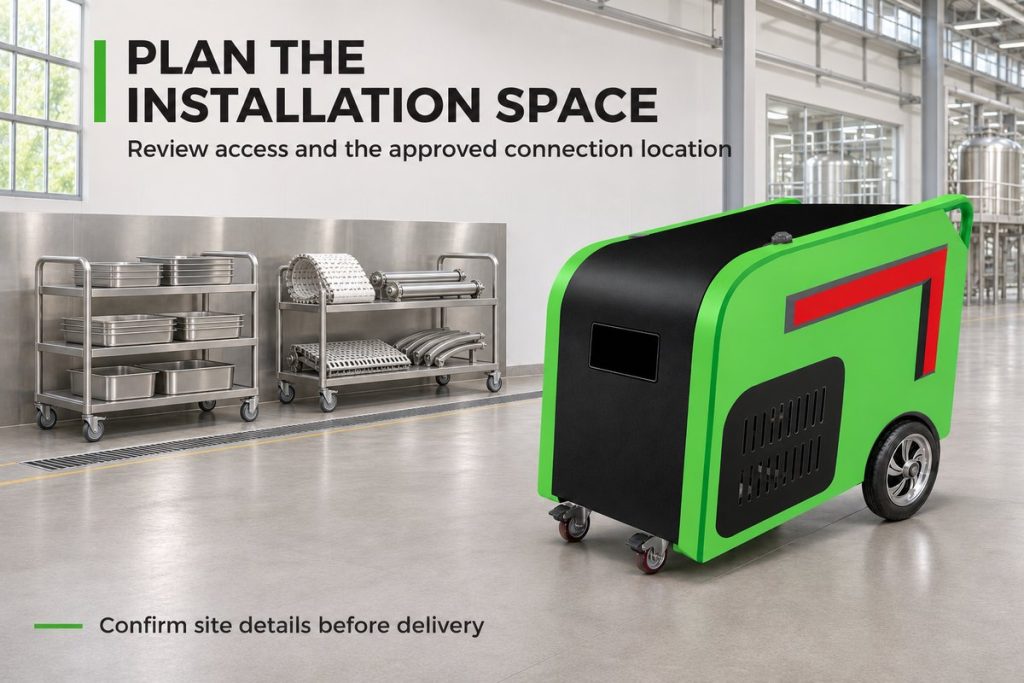
A suitable supply elsewhere in the building does not necessarily mean the proposed cleaning area is ready. Identify the planned machine position and the approved connection point during the site survey.
Record the distance between them, the intended cable route and the conditions around the connection. Note whether the machine will remain in one position or move between workstations.
If an extension arrangement is proposed, obtain manufacturer guidance and a professional assessment of the complete arrangement. Do not assume that a cable is suitable because its plug fits. Commercial pressure washer manuals can include specific requirements for extension cables and electrical connections.
Keep this information with the purchasing record so that the quotation reflects the intended working location.
5. Document the Agreed Configuration
Before shipment, request confirmation that the machine nameplate and documentation match the approved order. Keep the electrical supply specification alongside the cleaning specifications, rather than in a separate email that may be missed.
| Information to confirm | Purchasing purpose |
|---|---|
| Voltage, phase and frequency | Identify the exact supply configuration |
| Motor rating and heating arrangement | Clarify what the quoted power figure includes |
| Total electrical input and rated current | Support the site electrical assessment |
| Starting method | Support planning for startup conditions |
| Connection requirements and drawings | Prepare installation and commissioning |
During commissioning, have the responsible personnel check the installed configuration against the manufacturer’s instructions. Record the outcome and retain the documents for future maintenance or relocation.
Review industrial pressure washer power requirements again if the equipment moves to another facility or its configuration changes.
Discuss Your Site Requirements with LIEYING
When enquiring about a LIEYING industrial cleaning system, provide the cleaning application, required pressure and flow, heating preference, and available site supply.
Include voltage, phase, frequency and the intended working location. This gives the technical discussion a practical starting point and helps identify which configuration requires further review.
Explore LIEYING industrial cleaning solutions and discuss the electrical documentation needed for your project before placing an order.
Frequently Asked Questions
Is a three-phase connection enough to confirm compatibility?
No. Confirm the voltage and frequency as well, together with the complete machine requirements and site connection details.
Does the motor’s kW rating include electric heating?
Not necessarily. Ask the supplier to identify motor power, electric heating input where applicable, and the complete machine’s electrical input separately.
Can the same machine be used at another factory?
Compatibility must be checked again for the new location. Do not assume that another factory has the same supply or an approved connection arrangement.
What should I send with an equipment enquiry?
Send the cleaning task, target pressure and flow, heating preference, voltage, phase, frequency and intended machine location. Ask which additional site information is needed before ordering.