How to Clean Food Processing Equipment with Steam
To clean food processing equipment with steam, begin with the cleaning task rather than the machine settings. Identify the residue, confirm that the equipment can tolerate the proposed method, remove bulk contamination, and plan how loosened material will be collected.
Steam cleaning can be useful for selected stainless steel surfaces, accessible joints and equipment details. However, applying steam is only one part of a complete cleaning process. The result also depends on access, operator technique, residue removal and verification.
This guide explains how to build a practical steam-cleaning workflow within your facility’s approved sanitation program.
Where Does Steam Fit into Food Equipment Cleaning?
Steam can help loosen certain deposits through the combined action of heat, moisture and the cleaning accessory. Steam-cleaning systems are used on suitable stainless steel surfaces, fittings and kitchen equipment; some systems also provide vacuum recovery for collecting loosened material. Suitability still depends on the particular surface and application. Kärcher
Potential applications to assess include:
- Accessible stainless steel equipment exteriors.
- Removable parts approved for this cleaning method.
- Joints, edges and other details that cleaning accessories can reach.
- Localized deposits that require controlled cleaning.
Before selecting an application, define whether the surface contacts food, sits near exposed product, or belongs to a separate maintenance area. These distinctions should influence the cleaning procedure and the acceptance criteria.
Cleaning and Sanitizing Are Different Steps
Cleaning removes contamination. Sanitizing reduces microorganisms to an acceptable level under the conditions of the approved process. The Canadian Food Inspection Agency explains that sanitizing follows cleaning because it works best on surfaces with minimal remaining soil. inspection.canada.ca
A steam plume or a high generator temperature does not, by itself, demonstrate that a food-contact surface has been adequately sanitized.
If steam is intended to provide a sanitizing treatment, the facility needs evidence supporting the actual application conditions. Follow the approved sanitation procedure rather than assuming that every steam-cleaning pass delivers the same microbial reduction.
For further guidance, see the CFIA Cleaning and Sanitation Program.
Step 1: Confirm the Equipment and Steam Are Suitable
Review the equipment manufacturer’s cleaning instructions. Confirm which surfaces, seals, belts, coatings and components can receive steam, and which areas must be excluded.
Treat equipment suitability and steam suitability as separate questions.
For direct contact with food-contact surfaces, assess the steam supply, feed water, treatment chemicals and distribution system. CFIA guidance identifies these as factors that can affect whether steam introduces contamination. A machine’s electric heating system alone does not establish that its steam is suitable for food-contact use. inspection.canada.ca
Before a trial, agree on:
- The exact equipment section to be cleaned.
- The residue to be removed.
- The approved accessories and operating conditions.
- The collection method.
- The criteria for accepting the result.
Step 2: Prepare the Area and Remove Bulk Residues
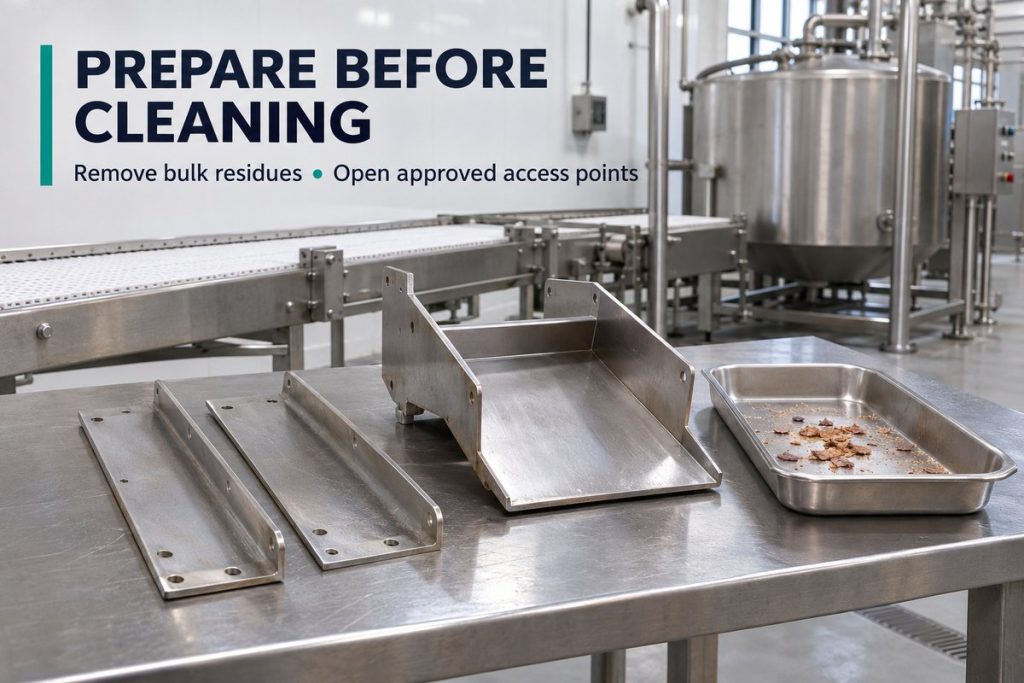
Schedule the work within the facility’s cleaning window. Remove or protect food, ingredients and packaging, and follow the site’s equipment isolation procedure before accessing cleaning points.
Disassemble only the parts identified in the equipment instructions. Use the designated tools to remove bulk material before the steam-cleaning stage. CFIA’s sanitation guidance recommends documenting equipment disassembly, cleaning tools and measures that protect food and packaging during cleaning. inspection.canada.ca
A useful preparation record identifies what has been removed and what remains to be cleaned.
For example, a removable guide may have contamination on its underside even when the visible top surface appears clean. Include that underside in the work instruction rather than relying on the operator to discover it during every cleaning session.
Before you clean food processing equipment with steam, confirm that the preparation checklist is complete and the designated cleaning points are accessible.
Step 3: Apply Steam Using a Defined Method
Follow the steam cleaner’s operating instructions and the approved site procedure. Use the selected accessory to work through the identified cleaning area in a controlled sequence.
Make the work instruction specific enough to repeat. It should identify the accessory, permitted settings, access points and the method used to remove loosened material.
Avoid using maximum output as the default measure of cleaning quality. During the trial, assess whether the accessory reaches the target deposit and whether the operator can see the result.
A practical trial sheet can include:
| Trial item | What to document |
|---|---|
| Equipment area | Exact section and cleaning points |
| Residue | Type and condition before cleaning |
| Accessory | Approved nozzle, brush or recovery tool |
| Operating method | Settings and technique used |
| Collection | Where loosened material is captured |
| Result | Remaining residue and required follow-up |
When deciding how to clean food processing equipment with steam, this application record is more useful than comparing pressure ratings alone.
Step 4: Remove Loosened Residues and Manage Condensate
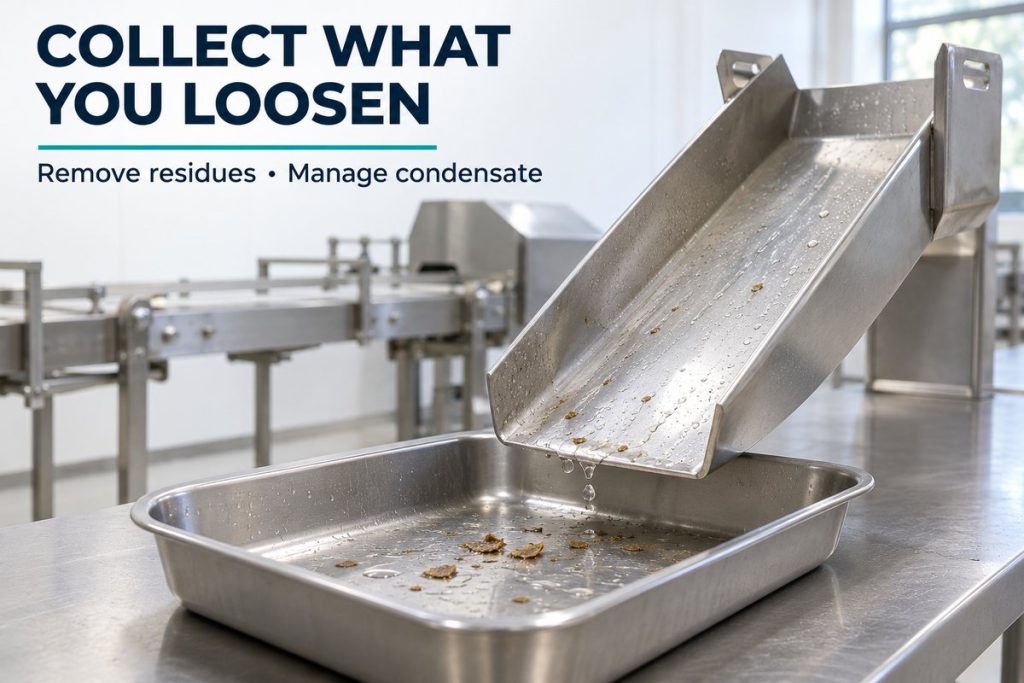
Plan the collection stage before starting. Decide whether the task requires an approved wipe, a separate recovery tool or a steam-vacuum system.
Steam-vacuum equipment combines steam application with suction, but the recovery arrangement must still suit the task and the contamination being collected. Kärcher
Inspect the whole cleaned section, including locations where loosened material could remain. A surface may look improved while residue has simply moved to an adjacent edge or recess.
Low-moisture production areas need particular attention. Steam can produce condensate, so it should not automatically be treated as a moisture-free cleaning method. For low-moisture food operations, moisture management and the condition of surfaces before reuse are important considerations. U.S. sanitary-operation provisions specifically address clean, dry conditions for these food-contact surfaces. govinfo.gov
Have the sanitation team approve the method for the relevant zone before introducing it into routine production cleaning.
When you clean food processing equipment with steam, include residue collection in the work instruction so operators know how to complete each cleaning stage.
Step 5: Address Allergens and Any Required Sanitizing
Do not assume that heat alone eliminates allergen risk. CFIA identifies effective cleaning and validation as important controls against allergen cross-contact, and notes that heated food proteins can be difficult to remove. inspection.canada.ca
If the equipment handles different allergen profiles, follow the approved changeover procedure. Steam should not replace required detergent cleaning, rinsing or other steps without supporting evidence.
Complete any required sanitizing stage according to the facility’s established process.
The question is not simply whether steam was used. It is whether the complete procedure achieved the required result for that product, surface and production environment.
Step 6: Verify and Release the Equipment
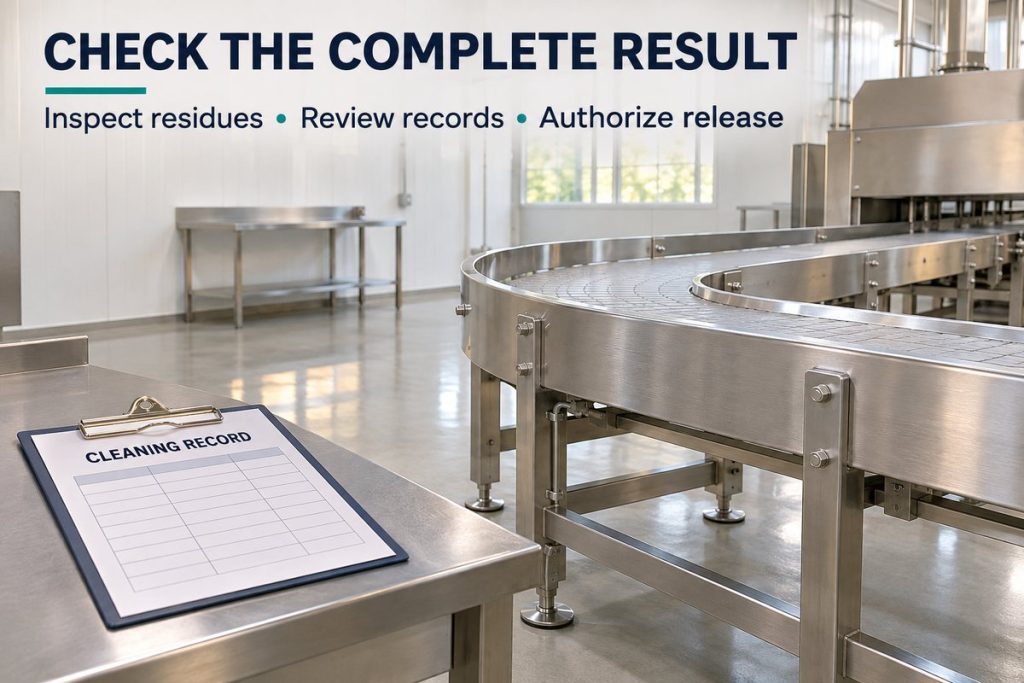
Inspect the designated cleaning points before reassembly and production release. Record remaining contamination and complete any corrective cleaning.
Use the verification methods specified by the sanitation team. Where allergen control is required, select a method appropriate to the target allergen. ATP testing is a nonspecific indicator and should not be treated as proof that a particular allergen has been removed. inspection.canada.ca
A practical handover record includes:
- Equipment identification.
- Date and operator.
- Cleaning method and accessories.
- Inspection or test results.
- Corrective actions.
- Authorization to return the equipment to service.
Keep the record tied to the actual equipment section so recurring problems can be investigated.
Choosing a Steam-Cleaning System for the Application
If you plan to clean food processing equipment with steam, give the supplier a clear description of the equipment, residues and available cleaning window.
Start a supplier discussion with photographs of the equipment and representative residues. Include the available cleaning window, access restrictions and the proposed collection method.
For the LIEYING product range, distinguish the cleaning functions:
| System | Application discussion |
|---|---|
| SI industrial steam | Steam application for heating and loosening suitable deposits |
| SV steam vacuum | Steam, washing and extraction where integrated recovery is required |
| HP hot water pressure | Pressure and water flow where an approved washdown method is appropriate |
These are different cleaning approaches. Choose the configuration through an application assessment rather than assuming that one system can replace every stage.
For an SI steam-cleaning trial, ask the supplier to demonstrate the actual residue, accessory access and working duration. Confirm food-contact steam requirements separately with the facility’s technical team.
Frequently Asked Questions
Can you clean food processing equipment with steam without detergent?
Some cleaning tasks may be completed without added detergent. Others require the cleaning chemistry specified in the sanitation procedure. Assess the actual residue and verify the result before changing an established process.
Does steam cleaning automatically sanitize equipment?
No. A cleaning pass does not automatically demonstrate a validated sanitizing treatment. Follow the facility’s approved requirements for the surface and application.
What temperature should be used?
There is no single setting suitable for every food-processing application. Use the equipment instructions and approved cleaning procedure. A generator setting should not be treated as evidence of the treatment achieved across every surface.
Can steam replace a CIP system?
Do not assume that portable steam cleaning can replace an established clean-in-place process. Review the equipment design, internal access and existing sanitation requirements before changing methods.
Plan the Complete Cleaning Process
To clean food processing equipment with steam effectively, define the task from preparation through to production release. Match the cleaning method to the residue, collect the loosened contamination and verify the completed work.
For application assessment, visit LIEYING industrial cleaning solutions. Share equipment photographs, residue details, cleaning frequency and recovery requirements to discuss a suitable steam-cleaning configuration.