Industrial pressure washer hose length affects more than how far an operator can walk from the machine. It also influences routing, handling and the pressure available downstream while water is flowing.
A longer hose may let a team reach another side of a large component without moving the cleaner. It can also add weight, create awkward routes and introduce additional pressure loss. The practical choice depends on the machine, water flow, hose diameter and work area.
Before requesting an extension, start with the cleaning route and the conditions the complete assembly must support.
Measure the Route the Hose Will Actually Follow
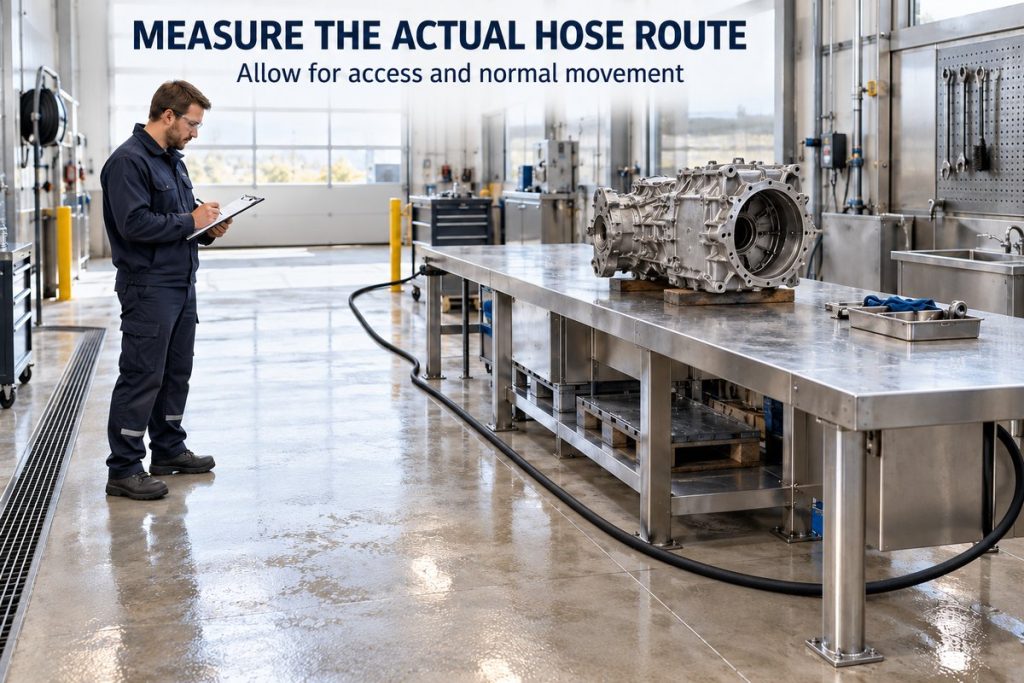
The distance from the machine to the component is only a starting point.
A hose may need to pass around a workbench, follow a permitted walkway or reach the far side of a detached machinery housing. A straight-line measurement can underestimate the usable length required.
Map the proposed machine position and the furthest cleaning point. Include enough handling allowance for normal movement without pulling on the connections. Avoid creating excessive loose hose simply because a longer assembly is available.
For example, a component located eight metres from the machine may require more than eight metres of hose once the route around a bench is included. This is a layout example, not a recommendation for a particular hose length.
Record whether the machine can be repositioned between tasks. Moving a mobile cleaner to a suitable nearby position may be more practical than carrying one long hose through several work areas.
When choosing industrial pressure washer hose length, measure the route around benches and equipment rather than relying on straight-line distance.
Understand Pressure Loss While Water Is Flowing
Industrial pressure washer hose length should be assessed together with inside diameter and operating flow.
Water flowing through a hose experiences friction losses. For the same hose construction, inside diameter and flow, a longer run generally produces more pressure loss. A smaller inside diameter can also increase losses substantially.
Cat Pumps publishes a hose friction-loss chart relating flow, inside diameter and pressure drop per stated hose length. Such information helps explain why length alone cannot determine the pressure loss for every setup. catpumps.com
Ask the supplier to review the proposed hose assembly at your intended operating flow. Include couplings, reels and other components in that review rather than treating the hose as the entire flow path.
A machine-mounted gauge does not automatically show the pressure available near the gun. Ask where pressure is measured and whether the quoted working condition includes the proposed hose and accessories.
Do not apply a universal percentage loss to every extension. Any estimate should state the hose dimensions, flow and assumptions used.
Confirm Hot-Water Compatibility for the Complete Assembly
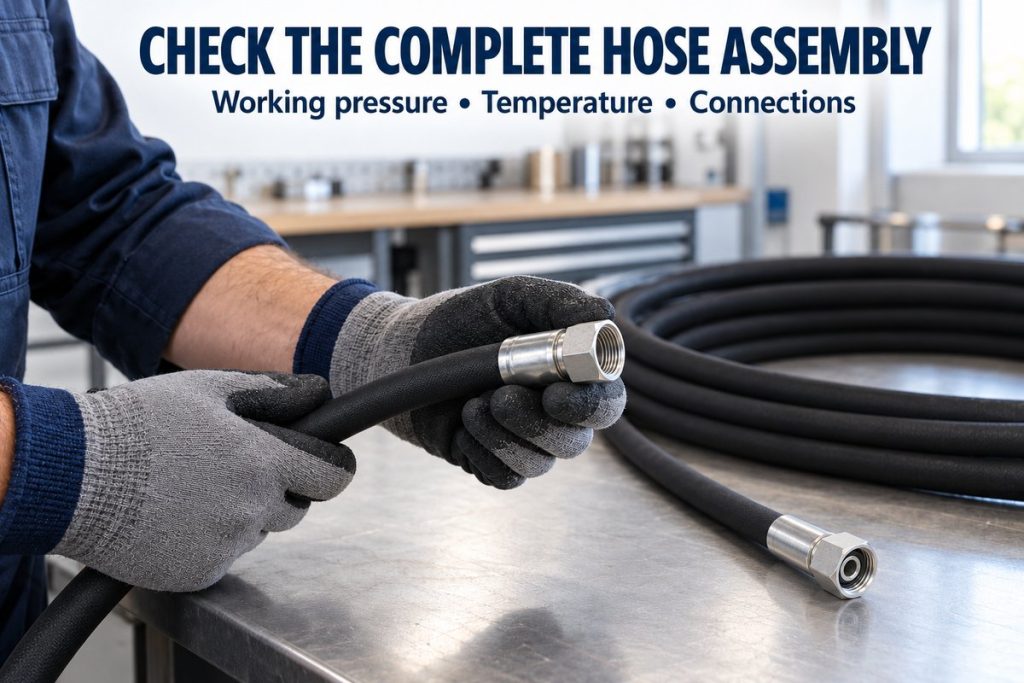
A hose that connects physically is not necessarily suitable for the intended service.
For hot-water cleaning, obtain confirmation of the permitted working pressure, water temperature and connection arrangement. The hose, end fittings, couplings and any reel must be suitable for the proposed conditions.
Do not assume that a hose’s printed pressure rating establishes the rating of every assembled connection. Parker’s industrial hose guidance explains that assembly pressure ratings depend on the component ratings and the approved assembly method. parker.com
Ask for identification that makes future replacement straightforward:
- Hose assembly part number and overall length.
- Inside diameter.
- Approved working pressure and temperature for the intended medium.
- End connection type and size.
- Any restrictions on chemicals, routing or use with a reel.
If an extension adds adapters, have those included in the supplier’s compatibility review. Avoid building an unverified chain of fittings to make a connection fit.
Consider Handling as Well as Reach
The easiest hose to specify on a quotation may not be the easiest to use through a working day.
A larger inside diameter may reduce friction loss at a given flow, but the resulting assembly can also be heavier or harder to move. Assess the actual hose construction and handling characteristics rather than judging by diameter alone.
Review the intended route for sharp edges, tight bends, vehicle crossings and locations where the hose could rub repeatedly. Follow the assembly manufacturer’s routing instructions and minimum bend radius.
Where a reel is proposed, confirm its ratings and operating instructions for the complete configuration. Also consider where the hose will be stored, how it will be cleaned externally and how operators will inspect it.
These details are particularly useful when the same equipment moves between machinery repair bays, industrial maintenance areas and prepared wash stations.
Test the Setup at the Furthest Cleaning Point
Before ordering, evaluate industrial pressure washer hose length using the proposed route and accessories.
A short demonstration next to the machine does not represent a job performed at the other end of the work area. Ask for a trial that includes normal hose movement and the furthest intended cleaning position.
Use a simple record:
| Trial item | What to confirm |
|---|---|
| Machine | Exact model and operating settings |
| Hose | Length, inside diameter and assembly identification |
| Connections | Couplings, adapters and reel, where fitted |
| Work area | Actual route and furthest cleaning point |
| Performance | Cleaning result and any verified operating measurements |
| Handling | Drag, access, storage and repositioning needs |
If temperature delivery matters to the task, include it in the evaluation under the intended work pattern. Do not infer the condition at the tool from a control setting alone.
Compare the results against a defined cleaning requirement. The aim is sufficient usable reach with an appropriate complete setup, rather than the longest possible hose.
Confirm industrial pressure washer hose length by testing the complete setup at the furthest planned cleaning point.
Discuss Your Hose Requirements with LIEYING
When discussing a LIEYING high-pressure hot-water cleaning application, share the machine model, workpiece photographs and a sketch of the intended work area.
Include your required reach, operating flow, temperature requirements and any existing hose or connection details. Explain whether the cleaner will remain in one position or move between tasks.
Request written confirmation of the proposed hose assembly and accessory configuration. This helps connect the industrial pressure washer hose length decision to the actual cleaning job.
Explore LIEYING industrial thermal cleaning solutions.
Frequently Asked Questions
Does a longer hose always cause a noticeable cleaning problem?
No. The practical effect depends on length, inside diameter, flow and the complete configuration. An appropriate extension may work satisfactorily; confirm suitability for the exact setup.
Is there one maximum hose length for all industrial pressure washers?
No. Use the equipment supplier’s guidance for the exact machine and hose assembly. A limit stated for another product is not transferable.
Can I use an ordinary cold-water hose on a hot-water machine?
Only if the complete assembly is approved for the intended water temperature, working pressure and other operating conditions. Connection fit alone is insufficient.
Should I increase machine pressure to compensate for an extension?
Do not raise settings beyond the approved operating limits. Have the supplier assess the hose and complete configuration before changing the setup.
Technical References
- Cat Pumps: Industrial Hoses and Hose Friction Loss Chart
- Parker: Hose Products Division Catalog 4400
These references provide general technical background. Final selection should follow the instructions for the actual machine and approved hose assembly.