A hot water pressure washer may offer high pressure, adjustable temperature and a strong cleaning jet. But these specifications do not show how much water, energy or detergent a complete cleaning task will consume.
For industrial buyers, hot water pressure washer efficiency should be evaluated against a defined result: a suitable surface cleaned to an agreed standard, with wastewater and final cleanup included.
This guide explains six checks that help maintenance teams, cleaning contractors and procurement managers compare equipment using practical evidence.
Why Efficiency Matters in Industrial Cleaning
Industrial cleaning uses resources both during spraying and outside the visible cleaning stage.
Water may be consumed during pretreatment, washing, rinsing and work-area cleanup. Energy may be used for pumping, heating, warm-up and standby. Detergent use and wastewater handling add further operating requirements.
A machine with a lower advertised flow rate is therefore not automatically the more efficient choice. Likewise, a higher outlet temperature does not by itself demonstrate lower energy consumption.
The useful question is:
How many resources does the complete process require to achieve an acceptable cleaning result?
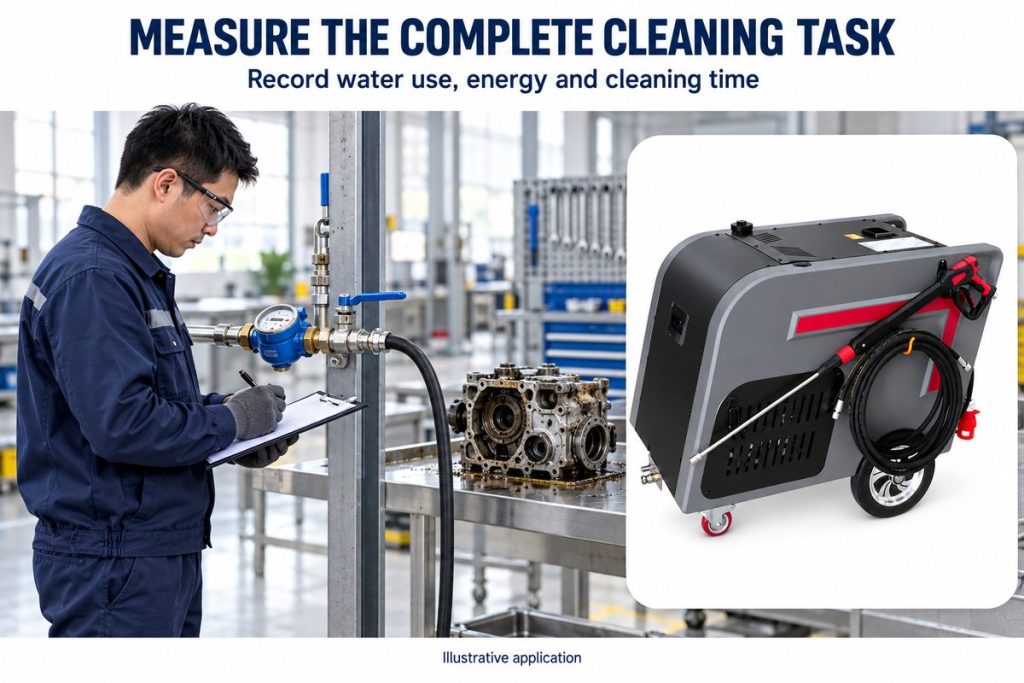
1. Compare Water Use per Completed Task
Flow rate describes water delivery over time. It does not describe total water use unless operating time is also known.
For an initial estimate:
Water delivered = operating flow rate × actual spray time.
Consider two illustrative cleaning trials:
- Setup A operates at 10 L/min for 30 minutes, delivering 300 liters.
- Setup B operates at 15 L/min for 15 minutes, delivering 225 liters.
Setup B has the higher flow rate but uses less water during the stated spraying period.
These figures are examples, not LIEYING performance data. They also exclude any additional pretreatment, rinsing or cleanup water.
For a meaningful comparison, use representative components with similar contamination and the same required finish. Record all water entering the process, including repeated cleaning where the first pass is insufficient.
Hot water pressure washer efficiency becomes easier to assess when the result is expressed as liters per accepted component, square meter or completed job.
2. Evaluate Heating Energy Under Comparable Conditions
Heating performance depends on the working conditions.
A supplier’s energy-consumption figure is difficult to interpret without knowing the inlet-water temperature, operating flow, achieved outlet temperature and test duration.
Ask suppliers to identify:
- The heating method and energy source.
- The inlet-water temperature during testing.
- The working flow and pressure.
- The outlet temperature achieved during sustained spraying.
- Warm-up and standby conditions.
- The electricity and fuel consumed during the complete test.
For an electrically driven, fuel-heated machine, record electricity and heating fuel separately. Comparing only motor power leaves out the heating input.
Avoid comparing one machine during warm-up with another after it has already reached operating temperature. Start each trial from a clearly documented condition.
For purchasing decisions, energy per completed job is more informative than an isolated hourly figure. Keep the underlying consumption measurements separate from energy prices so that operating costs can be recalculated for the buyer’s location.
3. Match Temperature and Detergent to the Contamination
An efficient cleaning process uses settings appropriate to the deposit and surface.
Higher temperature may help soften suitable oily contamination, but maximum heat is not necessary for every task. Temperature limits for coatings, seals and other materials must also be respected.
Similarly, detergent should be selected and dosed for the application. Record the product, dilution, contact time and rinse requirements when comparing trials.
Useful purchasing questions include:
- Can operators adjust the relevant cleaning settings?
- Are the permitted operating combinations clearly documented?
- Does the detergent system support controlled dosing?
- Are chemical-compatibility limitations available in writing?
- Can the supplier demonstrate a repeatable process for the actual contamination?
Reducing detergent consumption can be a useful objective, but a pressure washer should not be described as universally chemical-free.
Assess water, energy, detergent and cleaning time together. A reduction in one input may be accompanied by an increase in another.
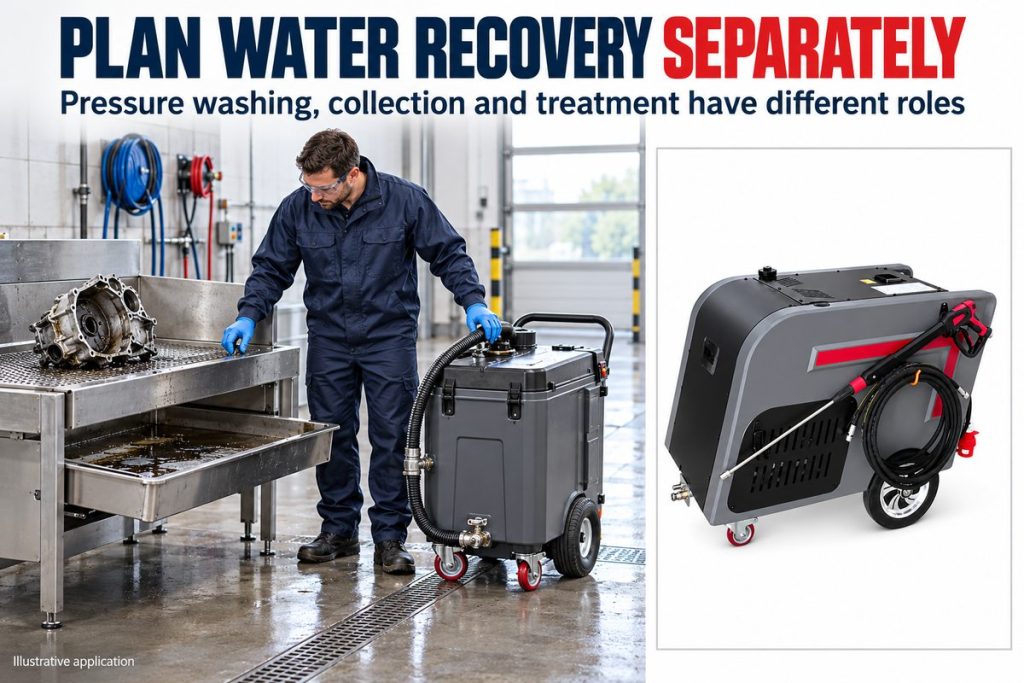
4. Separate Cleaning, Water Recovery and Water Treatment
A pressure washer delivers cleaning water. Recovery equipment collects used water. Treatment equipment addresses selected contaminants.
These are different functions, even when they form part of one installation.
Before purchasing, establish what is actually included in the quotation:
- Pressure washer and cleaning accessories.
- Wash-area containment.
- Recovery pump or compatible liquid-collection equipment.
- Storage tanks.
- Filtration or other treatment stages.
- Controls, installation and ongoing maintenance.
Do not assume that a machine described as efficient includes wastewater recovery or recycling.
If reuse is proposed, confirm both treatment performance and the pressure washer manufacturer’s inlet-water requirements. Water that looks clear may still be unsuitable for the pump, heating system or cleaning task.
The U.S. EPA’s equipment-washing guidance discusses containment, collection, treatment and reuse as planning considerations. The appropriate arrangement for an individual industrial site must also account for its wastewater and applicable local requirements.
5. Check What Environmental Claims Actually Mean
Environmental documentation can support procurement, but different documents answer different questions.
ISO 14001 concerns an organization’s environmental management system. It does not, by itself, establish a pressure washer’s water consumption, fuel consumption or cleaning performance.
Where certification is presented, check the named organization, certified scope, issuing body and validity. If a document relates to a component or a different model, ask how it applies to the proposed equipment.
For performance claims such as “water-saving” or “energy-efficient,” request the underlying comparison:
- What was the baseline?
- Which model and configuration were tested?
- What contamination and surface were used?
- What result defined completion?
- Were warm-up, rinsing and cleanup included?
- Who performed or verified the measurements?
Broad statements such as “meets international environmental standards” should be supported by specific, relevant documents.
A clear technical explanation is more useful than a collection of certification logos without scope or context.
6. Assess Repeatability, Maintenance and Total Operating Cost
Hot water pressure washer efficiency should remain practical over repeated use.
Include maintenance and service access in the evaluation. Ask about routine inspection, water-quality requirements, filter servicing, heating-system maintenance and replacement-part availability.
These requirements vary by machine, so use the proposed model’s instructions rather than assumptions based on another product.
For a representative trial, agree on a simple recording sheet:
- Component or area cleaned.
- Starting contamination.
- Required cleaning result.
- Operating settings and accessories.
- Total fresh water used.
- Electricity and fuel used.
- Detergent consumed.
- Setup, washing and cleanup time.
- Rework and wastewater-handling requirements.
Repeat the trial where practical to understand variation.
When calculating cost per completed job, include labor, utilities, detergent, routine maintenance and wastewater handling. Keep assumptions visible so that competing quotations can be compared on the same basis.
Discussing an Application with LIEYING
For a LIEYING industrial cleaning inquiry, provide more than the required pressure.
Share photographs of the contamination, component dimensions, surface materials, expected workload, available utilities and the existing wastewater arrangement.
Also explain the intended improvement: lower water consumption, reduced cleaning time, controlled detergent use or a more manageable cleaning process.
These details help define a suitable configuration and a relevant demonstration. Confirm model specifications, included accessories and supporting documents in the quotation.
Explore LIEYING industrial cleaning solutions:
Frequently Asked Questions
Does a lower flow rate always save water?
No. Total water use depends on flow, actual spraying time and the rest of the cleaning process. Compare completed tasks with equivalent results.
Does hotter water always improve efficiency?
No. The appropriate temperature depends on the contamination and material. Evaluate the cleaning benefit alongside the energy required.
Does ISO 14001 certify a pressure washer’s energy efficiency?
No. ISO 14001 addresses an organization’s environmental management system. Equipment-performance claims need their own relevant evidence.
Does water recovery mean the water can be reused immediately?
No. Collection and treatment are separate functions. Reuse requires suitable water quality and compatibility with the equipment and application.
What evidence should a buyer request first?
Start with the exact model specification, a representative cleaning trial, measured resource consumption and a clear statement of what the quotation includes.