Grease redeposition is a common challenge during industrial hot water pressure washing. Even after visible oil, grease, and sludge have been removed from machinery, loosened contamination may settle back onto cleaned surfaces.
For industrial maintenance teams, this can result in repeated cleaning, increased water consumption, and inconsistent surface cleanliness.
The problem is not always caused by insufficient pressure. Effective grease removal depends on the combined action of temperature, pressure, water flow, nozzle selection, cleaning direction, and wastewater management.
In this guide, we explain why grease redeposition happens, how hot water pressure washing can help, and seven practical ways to prevent contamination from returning to cleaned equipment.
Table of Contents
- What Is Grease Redeposition?
- Why Does Grease Return After Cleaning?
- How Hot Water Helps Remove Industrial Grease
- Why Pressure and Flow Rate Must Work Together
- How Nozzle Selection Affects Cleaning Results
- Why Cleaning Direction Matters
- How to Manage Oily Wastewater
- A Practical Industrial Grease Cleaning Procedure
- Choosing a Suitable Hot Water Pressure Washer
- 7 Practical Tips to Prevent Grease Redeposition
- Common Cleaning Mistakes to Avoid
- Frequently Asked Questions
- Conclusion
1. What Is Grease Redeposition?
Grease redeposition occurs when loosened oily contamination returns to a previously cleaned surface or settles on another part of the equipment during the cleaning process.
For example, when cleaning an industrial gearbox housing, hot water can help soften thick grease deposits. High-pressure water then helps detach these deposits from the metal surface.
However, if the contaminated water is not properly removed, oil droplets, suspended particles, and cleaning residues may remain around the equipment.
As the surface cools and water evaporates, a thin oily film can become visible again.
This problem may occur during:
- Industrial machinery maintenance
- Engine and transmission cleaning
- Heavy equipment degreasing
- Hydraulic system component cleaning
- Manufacturing equipment maintenance
- Metal component reconditioning
- Construction equipment cleaning
Although the contamination may initially appear to be removed, grease redeposition can reduce cleaning consistency and create unnecessary repeat work.
The objective of an effective industrial cleaning process is therefore not only to loosen grease but also to transport and collect the contamination safely.
2. Why Does Grease Return After Cleaning?
Several factors can cause grease redeposition during industrial equipment cleaning.
2.1 Incomplete Contamination Removal
Hot water can help soften grease, while pressure provides the mechanical action needed to release contamination from the surface.
However, the cleaning process is incomplete if the loosened material remains in the work area.
Oil droplets and fine particles may settle onto adjacent equipment surfaces, especially when water flow and drainage are not properly controlled.
2.2 Insufficient Final Rinsing
Some cleaning processes remove visible grease but leave behind detergent residue, emulsified oil, or suspended particles.
These remaining substances can contribute to surface contamination after drying.
A controlled final rinse helps remove residual material and reduces the likelihood of grease redeposition.
2.3 Contaminated Cleaning Water
Some industrial facilities use recycled wash water.
While water recycling can reduce consumption, inadequate filtration or oil separation may allow contamination to build up in the cleaning system.
If highly contaminated water is reused without suitable treatment, it can reduce cleaning quality.
2.4 Incorrect Cleaning Direction
Cleaning direction influences how contaminated water moves across machinery surfaces.
For example, directing oily runoff toward an area that has already been cleaned may create additional work.
A planned cleaning sequence helps control the movement of grease and dirty water.
2.5 Poor Wastewater Management
Without appropriate containment or collection, oily wastewater may accumulate beneath the equipment and splash back onto cleaned surfaces.
Grease redeposition is therefore closely connected to drainage, wastewater collection, and the overall cleaning workflow.
[Insert Image 1: Grease buildup and redeposition on industrial machinery]
3. How Hot Water Helps Remove Industrial Grease
Temperature plays an important role in industrial grease removal.
Many industrial oils and greasy deposits become less viscous when heated, making them easier to loosen and displace.
An industrial hot water pressure washer combines thermal energy with mechanical cleaning action.
Thermal Action
Hot water helps soften suitable oily deposits and reduce their resistance to removal.
This can be especially useful when cleaning machinery covered with lubricants, oily sludge, and accumulated grease.
Mechanical Action
Water pressure helps detach softened contamination from the equipment surface.
Appropriate pressure is important because excessive force can damage sensitive components, seals, coatings, or surface finishes.
Contamination Transport
After grease has been loosened, adequate water flow helps carry the contamination away.
However, heat alone cannot completely prevent grease redeposition.
If loosened contamination remains in the rinse water or returns to the cleaned surface, the problem may continue.
Why Temperature Control Matters
Different surfaces and contamination types require different cleaning temperatures.
Operators should consider:
- Grease composition and thickness
- Surface material
- Heat-sensitive components
- Protective coatings
- Seal compatibility
- Required cleaning results
- Equipment heating capacity
The goal is to apply sufficient heat for effective cleaning without creating unnecessary material or equipment risks.
4. Why Pressure and Flow Rate Must Work Together
One of the most common misunderstandings in industrial pressure washing is that higher pressure always produces better cleaning results.
In reality, pressure and flow rate serve different purposes.
Pressure: Detaching Contamination
Water pressure provides mechanical force that helps release dirt, grease, and other deposits from the surface.
For stubborn industrial contamination, appropriate pressure can improve the removal process.
However, excessive pressure may cause:
- Surface damage
- Seal penetration
- Coating deterioration
- Unnecessary splashing
- Increased operator safety risks
Flow Rate: Carrying Contamination Away
Flow rate describes the volume of water delivered over time.
After contamination is loosened, water flow helps move suspended particles, grease, and cleaning residues toward the collection area.
Insufficient flow may leave loosened deposits on the surface.
Excessive flow, on the other hand, may increase wastewater generation and exceed the drainage capacity of the cleaning site.
Why Balance Matters
Effective hot water pressure washing requires a suitable balance between temperature, pressure, and water flow.
For industrial grease removal:
Temperature helps soften contamination.
Pressure helps detach contamination.
Water flow helps carry loosened contamination away.
This combination can improve cleaning effectiveness when matched to the equipment surface and contamination level.
Properly balancing these factors is also important for reducing grease redeposition.
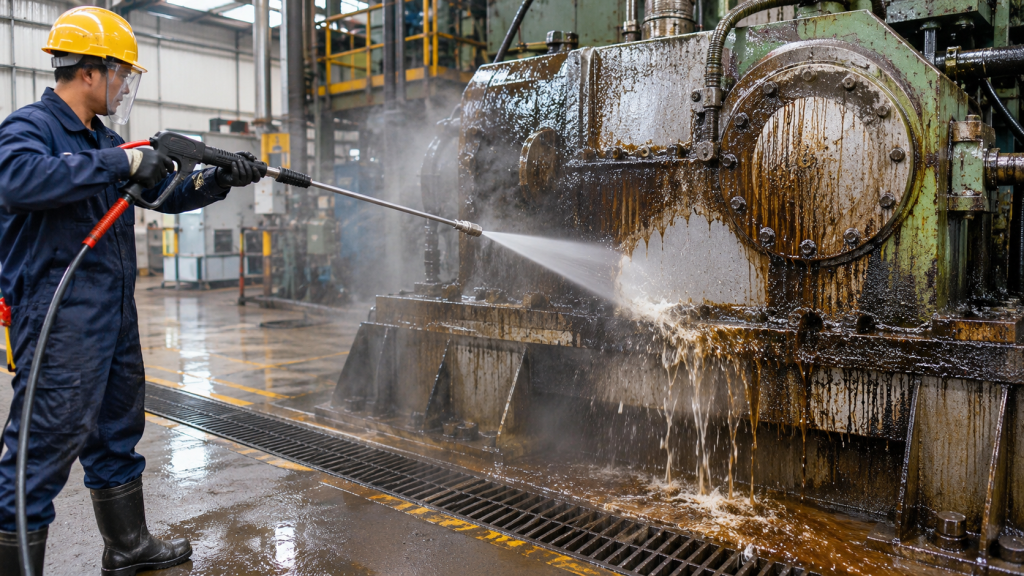
[Insert Image 2: Industrial hot water pressure washing in action]
5. How Nozzle Selection Affects Cleaning Results
The nozzle influences the distribution and impact of the water jet.
Selecting an appropriate nozzle can improve cleaning control and reduce unnecessary splashing.
Narrow Spray Nozzles
Narrow spray patterns concentrate water impact over a smaller area.
They may be useful for localized contamination on sufficiently durable surfaces.
However, concentrated spray should be used carefully around sensitive components.
Wide-Angle Spray Nozzles
Wide-angle spray patterns distribute water across a larger surface area.
They can be useful for controlled rinsing after heavy contamination has been loosened.
A suitable fan spray may help move oily residues toward a collection point.
Nozzle Distance
The distance between the nozzle and the surface affects cleaning intensity.
Working too close may damage materials or cause unnecessary splashing.
Working too far away may reduce the cleaning effect.
Operators should select nozzle type, spray angle, and working distance based on the specific application and equipment guidance.
Correct nozzle selection can support more consistent industrial cleaning while limiting unwanted contamination movement.
6. Why Cleaning Direction Matters
Cleaning sequence is another important factor in preventing grease redeposition.
When washing large equipment, contaminated water can travel across multiple surfaces before reaching the drainage area.
Without a defined cleaning direction, dirty runoff may spread over previously cleaned sections.
For many vertical surfaces, a top-to-bottom cleaning approach allows gravity to move water toward lower collection points.
However, the correct sequence depends on equipment geometry, contamination distribution, and drainage arrangements.
Recommended Cleaning Sequence
Step 1: Inspect the equipment.
Identify heavily contaminated areas and determine where wastewater will flow.
Step 2: Establish a collection route.
Select the drainage and containment arrangement before starting the cleaning process.
Step 3: Remove heavy deposits.
Where necessary, manually remove thick accumulated grease before pressure washing.
Step 4: Clean in controlled sections.
Avoid directing contaminated water toward already cleaned surfaces.
Step 5: Perform a final rinse.
Use a suitable rinsing procedure to remove residual contamination.
Step 6: Inspect the results.
Check corners, joints, recesses, and drainage areas for remaining deposits.
A controlled sequence helps reduce repeated washing and improves overall cleaning consistency.
7. How to Manage Oily Wastewater
Wastewater management is an essential part of industrial hot water pressure washing.
Oily wash water may contain:
- Industrial lubricants
- Grease and oil residues
- Suspended solids
- Detergents and cleaning agents
- Metal particles
- Other industrial contaminants
If contaminated wastewater spreads across the work area, it can contribute to grease redeposition and create environmental risks.
Establish a Designated Washing Area
Where appropriate, industrial equipment should be cleaned in an area designed for wastewater containment.
Containment barriers, drainage channels, collection trays, and recovery systems may be used depending on the facility.
Avoid Uncontrolled Discharge
Oily wastewater should not be allowed to enter storm drains or surrounding soil without appropriate authorization.
Wastewater handling must follow applicable environmental regulations.
Consider Oil-Water Separation
Some industrial applications require oil-water separators, filtration systems, or other treatment methods.
These systems can help manage collected contamination before reuse or disposal.
However, treatment requirements depend on the contaminants present and local discharge regulations.
Monitor Recycled Water Quality
Facilities using recycled cleaning water should monitor oil content, suspended solids, and filtration performance.
Poor-quality recycled water may reduce cleaning effectiveness and increase the risk of grease redeposition.
For additional information, see the U.S. Environmental Protection Agency guidance on industrial stormwater pollution prevention.
This guidance discusses potential pollutants from equipment washing and the importance of preventing contaminated wash water from entering stormwater systems.
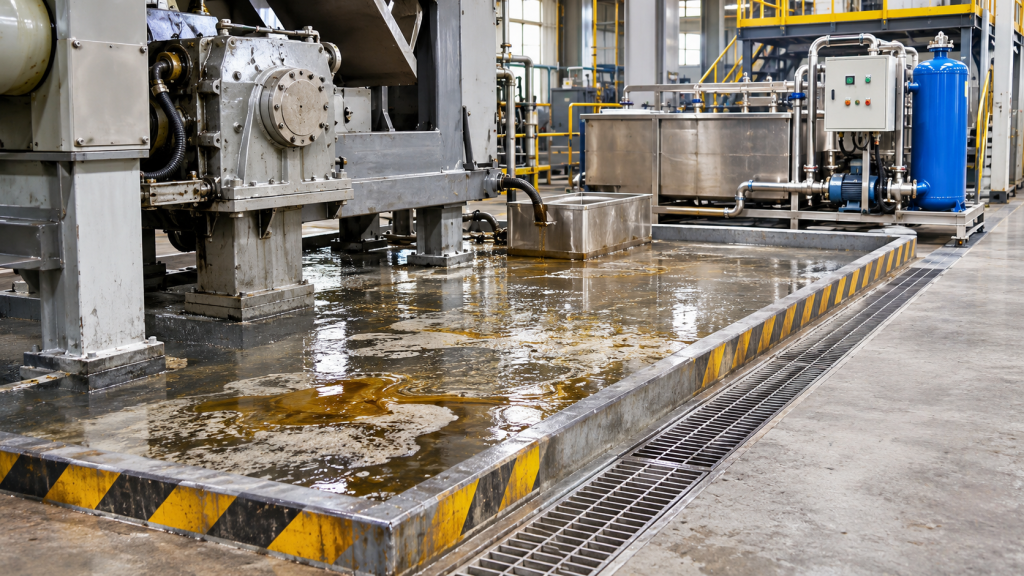
[Insert Image 3: Industrial oily wastewater collection and containment]
8. A Practical Industrial Grease Cleaning Procedure
A structured cleaning procedure can improve consistency and reduce unnecessary repeat work.
The following process provides a general approach for industrial machinery degreasing.
Stage 1: Pre-Cleaning Inspection
Determine the type of grease, contamination thickness, surface material, and sensitive components.
Check whether the equipment is suitable for hot water pressure washing.
Stage 2: Site Preparation
Protect vulnerable electrical components and temperature-sensitive parts.
Establish wastewater containment and drainage arrangements.
Follow appropriate equipment isolation and workplace safety procedures.
Stage 3: Heavy Deposit Removal
Remove thick accumulations of grease where practical.
This reduces the amount of contamination that must be transported by water.
Stage 4: Hot Water Pressure Washing
Apply suitable water temperature, pressure, flow rate, and nozzle settings.
Use controlled passes to detach oily deposits without unnecessarily spreading contamination.
Stage 5: Controlled Rinsing
Direct loosened contamination toward the designated collection area.
Avoid washing dirty runoff back across cleaned surfaces.
Stage 6: Wastewater Collection
Collect and manage oily wastewater using suitable recovery and treatment methods.
Stage 7: Final Inspection
Inspect the equipment after cleaning.
Check for oily films, residual grease, contamination trapped in recesses, and areas requiring additional attention.
When necessary, use an appropriate cleanliness verification method rather than relying only on visual appearance.
Following a structured procedure can help reduce grease redeposition and improve industrial maintenance efficiency.
9. Choosing a Suitable Hot Water Pressure Washer
Selecting the right cleaning equipment is important for achieving reliable industrial grease removal.
An industrial hot water pressure washer should be evaluated according to the actual cleaning application rather than maximum pressure alone.
9.1 Adjustable Working Pressure
Different components require different cleaning intensities.
Adjustable working pressure helps operators adapt the cleaning process to different contamination levels and surface conditions.
9.2 Appropriate Water Flow
Water flow should match the size of the cleaning area, contamination load, and available drainage capacity.
Sufficient flow helps remove loosened grease, while unnecessary water consumption should be avoided.
9.3 Stable Operating Temperature
Temperature stability is important during extended cleaning operations.
The equipment should be capable of delivering the required operating temperature at the selected flow rate under the intended working conditions.
9.4 Heating and Drive Configuration
Different industrial environments require different power and heating arrangements.
Electric-Heated Systems (HP-E)
Electric heating may be suitable for locations with adequate electrical capacity and restrictions on combustion exhaust.
Electric-Drive, Diesel-Heated Systems (HP-ED)
These systems use an electric motor to drive the high-pressure pump while diesel fuel provides the heating energy.
They may be suitable for industrial facilities where electrical pump operation is practical but electric heating capacity is limited.
Diesel-Drive Systems (HP-D)
Diesel-driven configurations may be useful for mobile or outdoor applications where reliable mains power is unavailable.
Fuel-powered systems require appropriate ventilation, exhaust management, and site safety measures.
9.5 Nozzle and Accessory Compatibility
Suitable accessories can improve access to large machinery, narrow spaces, and uneven surfaces.
Nozzle selection should be based on the cleaning objective rather than maximum impact alone.
9.6 Maintenance and Operating Reliability
For professional cleaning businesses, equipment reliability affects productivity.
Consider the accessibility of maintenance components, pump protection, heating-system service requirements, and suitability for repeated operation.
9.7 Wastewater Handling Requirements
The cleaning system must also match the site’s wastewater containment and treatment capabilities.
A washer that produces more wastewater than the facility can manage may create additional operational problems.
For heavy-duty industrial grease removal, selecting the right cleaning equipment is essential. Learn more about industrial hot water pressure washers and how temperature, pressure, and water flow work together to improve cleaning performance.
10. 7 Practical Tips to Prevent Grease Redeposition
Preventing grease redeposition during industrial cleaning requires more than removing visible oil.
These seven practical tips can help improve hot water pressure washing performance.
Tip 1: Select the Right Water Temperature
Use a suitable temperature to help soften greasy deposits without damaging seals, coatings, or temperature-sensitive materials.
The correct operating temperature depends on the contamination and the surface being cleaned.
Tip 2: Balance Pressure and Water Flow
Pressure helps detach contamination, while adequate water flow helps transport loosened grease away from the surface.
Avoid focusing exclusively on maximum pressure.
Tip 3: Choose the Correct Spray Nozzle
Select an appropriate spray pattern and working distance to reduce unnecessary splashing and improve cleaning control.
A suitable nozzle can improve the removal of contamination from different surface geometries.
Tip 4: Plan the Cleaning Direction
Clean in controlled sections and direct contaminated runoff toward designated collection areas.
Avoid washing oily wastewater across previously cleaned surfaces.
Tip 5: Avoid Reusing Heavily Contaminated Water
Poor-quality recycled water can contribute to grease redeposition and reduce cleaning consistency.
Use appropriate filtration, oil separation, and water-quality monitoring where recycling is implemented.
Tip 6: Perform a Thorough Final Rinse
Remove remaining grease, suspended particles, and cleaning residues using an appropriate final-rinse procedure.
Pay particular attention to corners, joints, and areas where liquid may accumulate.
Tip 7: Collect and Manage Oily Wastewater
Use suitable containment and wastewater recovery methods to prevent loosened oil from spreading across the cleaning area.
Proper wastewater management supports both cleaning consistency and environmental compliance.
These seven steps can help industrial maintenance teams reduce grease redeposition, improve surface cleanliness, and avoid unnecessary repeat washing.
11. Common Cleaning Mistakes to Avoid
Even experienced operators may encounter inconsistent cleaning results when the process is not properly controlled.
Mistake 1: Using Maximum Pressure for Every Task
Higher pressure does not automatically guarantee better grease removal.
Excessive pressure can damage equipment surfaces and increase unwanted splashing.
Mistake 2: Ignoring Water Flow
Loosened contamination must be carried away.
Insufficient flow may leave grease and particles on the cleaned surface.
Mistake 3: Using Excessive Heat
Higher temperature may help soften grease, but unnecessary heat can damage seals, coatings, and heat-sensitive materials.
Mistake 4: Reusing Contaminated Water
Inadequately treated wash water may leave residues and increase grease redeposition.
Mistake 5: Cleaning Without a Drainage Plan
Uncontrolled wastewater can spread contamination and create additional cleaning work.
Mistake 6: Skipping the Final Rinse
Residual detergent, suspended oil, and loosened particles may remain if rinsing is incomplete.
Mistake 7: Relying Only on Visual Inspection
Some oily residues are difficult to identify immediately after cleaning.
Where required, facilities should use appropriate cleanliness inspection procedures.
Avoiding these mistakes can improve overall industrial cleaning reliability.
12. Frequently Asked Questions
What Causes Grease Redeposition After Pressure Washing?
Grease redeposition may occur when loosened oil, contaminated cleaning water, or residual cleaning solution remains on the surface or settles onto previously cleaned areas.
Can Hot Water Prevent Grease Redeposition?
Hot water can help soften and remove many types of oily contamination, but it does not automatically prevent redeposition.
Effective rinsing, controlled cleaning direction, and wastewater management are also necessary.
Is Higher Water Pressure Better for Removing Grease?
Not always.
The appropriate pressure depends on the contamination, surface material, water flow, nozzle selection, and cleaning temperature.
Why Is Water Flow Important During Industrial Degreasing?
Water flow helps transport loosened contamination away from the surface.
Without adequate rinsing, grease and suspended particles may remain in the work area.
How Can Wastewater Recycling Affect Cleaning Quality?
Recycled water that contains excessive oil or suspended solids may reduce rinsing effectiveness.
Suitable filtration, oil separation, and water-quality monitoring are important.
Can Grease Redeposition Occur Even After a Surface Looks Clean?
Yes.
A surface may appear clean immediately after washing while still containing residual oily contamination.
A final inspection or suitable cleanliness verification method may be necessary.
What Type of Equipment Is Suitable for Heavy Industrial Grease Cleaning?
A hot water pressure washer may be suitable for many heavy-grease cleaning tasks.
The equipment should be selected according to contamination type, surface compatibility, working pressure, water flow, temperature requirements, power availability, and wastewater handling conditions.
13. Conclusion
Preventing grease redeposition requires more than increasing water pressure or cleaning temperature.
Effective industrial hot water pressure washing depends on a controlled process that loosens contamination, transports it away, and prevents it from returning to cleaned surfaces.
The most important factors include:
- Suitable operating temperature
- Balanced pressure and water flow
- Appropriate nozzle selection
- Controlled cleaning direction
- Effective final rinsing
- Proper wastewater collection
- Consistent surface inspection
By combining these practices, industrial maintenance teams can improve cleaning efficiency and reduce unnecessary repeat work.
The goal of industrial grease removal is not simply to loosen contamination. It is to remove it from the cleaning area while protecting equipment surfaces and managing wastewater responsibly.
Different contamination types require different cleaning methods. Explore our industrial cleaning equipment solutions to understand the applications of hot water pressure washing, industrial steam cleaning, and extraction systems.